WHITE PAPER

The Cognitive Split in Brownfield Engineering

Why telling an AI to think harder makes legacy refactoring worse — and the framework that fixes it.

Longer reasoning chains are meant to produce better code. In brownfield systems they often produce worse code, more confidently. This paper explains the mechanism, and sets out a protocol for refactoring legacy systems with AI that does not depend on the model guessing right.

Ivan Stankevichus, AI Engineer at ModernPath

Free · PDF · No email confirmation loop

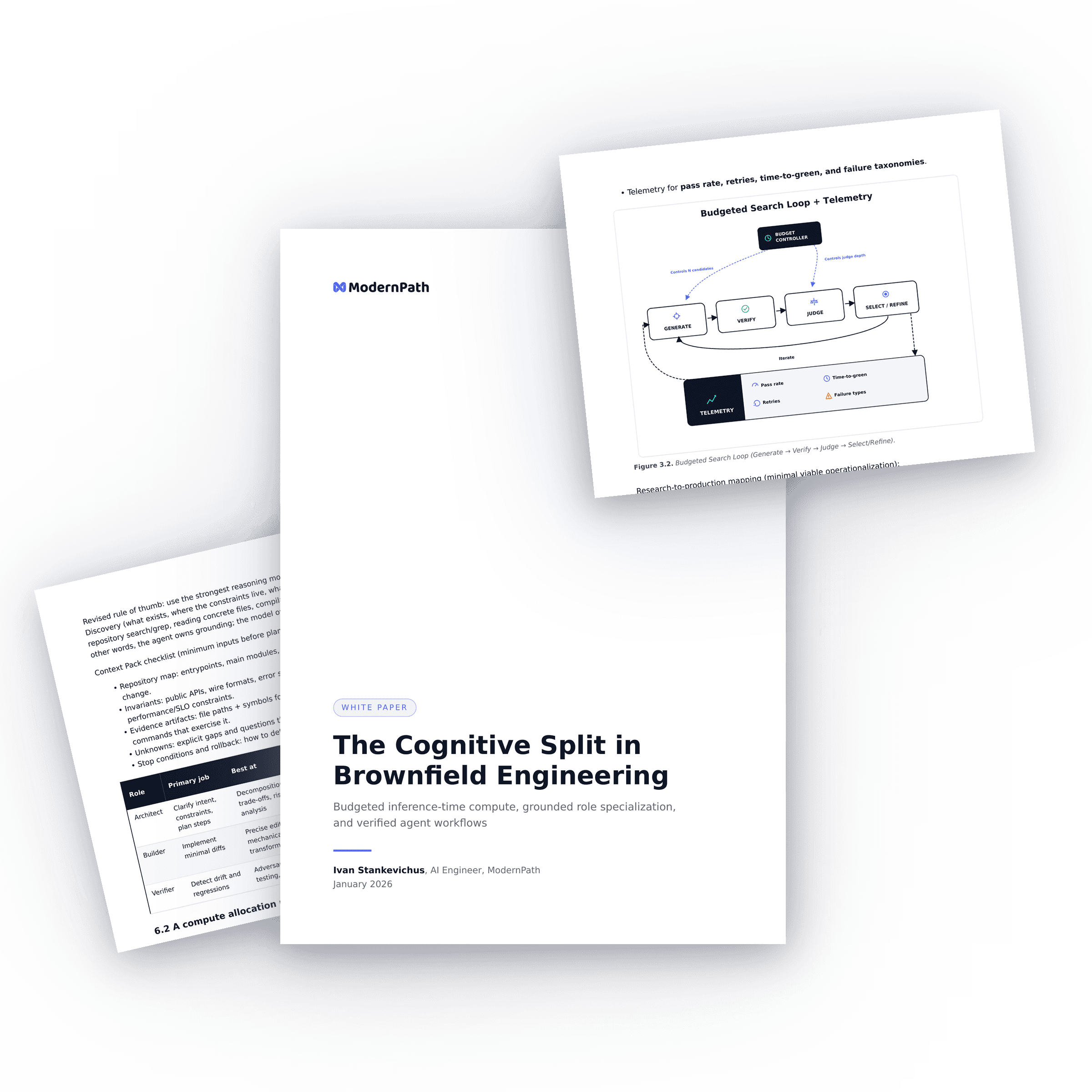
Three pages from the whitepaper The Cognitive Split in Brownfield Engineering: the title page, a page showing the Budgeted Search Loop diagram, and a page showing the role and compute-allocation table.

What's inside

The reasoning-momentum trap

Why extended thinking amplifies a wrong premise instead of catching it.

Discovery vs. synthesis

The two cognitive modes a refactor needs, why one model doing both degrades the output, and where to split them.

Why brownfield is structurally different

Greenfield has no accumulated architecture to violate. Legacy systems do, and that changes what "correct" means.

The EIA protocol

Evidence-first planning — gather, verify, then plan — so the specification is anchored to what the system actually is rather than what it ought to be.

Architect, Builder, Verifier

Role specialisation across a four-stage pipeline — pre-flight, plan, patch, verify — and what each stage has to prove before the next one starts.

Get the whitepaper

Free. Leave your email and the PDF downloads straight away.

The Cognitive Split in Brownfield Engineering · PDF

The download starts right after: no email confirmation loop.

About the author

Ivan Stankevichus — AI Engineer at ModernPath

Ivan works on grounded AI-assisted change in production brownfield systems, where the constraint is rarely the model and almost always the evidence available to it.

Prefer to read it in the browser first? Read the full article →

This is the 13%.

Writing code is roughly 13% of software delivery. Grounded refactoring is what makes that 13% reliable in systems that punish guesswork. The other 87% — requirements, planning, review, traceability — is what the Agentic Engineering OS runs.

See how it works →