mission control · your move
What the Knowledge Core actually builds
Sources: everything you already use
Keep every tool you run: the record starts from what exists, with provenance preserved on ingestion. As the System of Record takes over, you consolidate on your schedule, not ours.
Code repositories
Databases
Documents
Work management
Documentation
Integrations
APIs & feeds
Knowledge Core
A domain-driven model of your real system: architecture, patterns, conventions, and business rules, grounding every agent and human. Specifications are generated against the architecture you actually have; knowledge accuracy is the leading indicator of delivery success.
PatternsCapabilitiesSubsystemsDependenciesLibrariesRepository metadataTechnology stackCompliance artifactsDocumentsDesign systemPlanning sessions
Indexed context, lower token spend
Specification generation
Chat-based interface
Four architect agents run in parallel on every analysis
Domain Design
Architecture Quality
Dead Code
Code Health
Ledger: the System of Record
The real-time System of Record for intent, rules, and decisions. Every record is versioned, immutable, and attributable. History is kept, never overwritten.
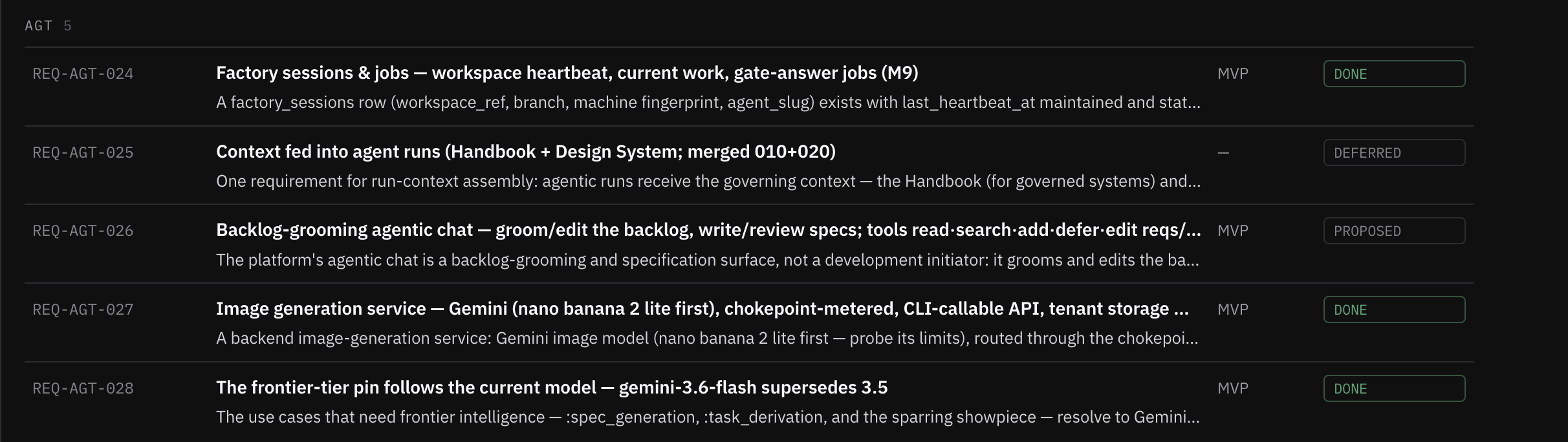
Requirements. Functional and non-functional, held as linked registers with a formal approval step
Business rules. Policies, constraints, and operating rules
ADRs & decisions. Architecture decision records and rationale
Standards & contracts. APIs, schemas, interfaces, agreements
Risks & constraints. Risks, assumptions, and dependencies
Why a ledger, not a wiki
Documentation drifts; a system of record does not. Requirements survive refactors, rewrites, and tool changes, and the platform can prove, at any moment, what was decided, by whom, and why.
Traceability & Mapping
Every requirement and rule in the Ledger is mapped, bidirectionally, to the artifacts that realize it: from a requirement to the code that implements it, and from any line of code back to the decision behind it.
Requirement
Design
Code
Tests
Evidence
Execution Loop
The platform runs the process and asks when your input is needed. Changes are reviewed against the specification that was agreed, not generic best practice.
- Intention
- Plan
- Implement
- Verify
- Validate
- Deliver
- Learn
Task derivation
A seven-phase pipeline turns specs into epics, stories, and sprint plans, exported to JSON, Markdown, or your tracker.
Verification & delivery
Red-first tests encode the acceptance criteria before code is written. Evidence (test runs, CI results, review outcomes) attaches to the requirement chain; approval gates control progression to done.
Harnesses: the tools you already use
MCP tools, hooks, and APIs drive every harness with the same context, rules, and acceptance criteria. Switch tools without losing the record, and source code stays in your environment.
Claude CodeCursorCodexGitHub CopilotWhatever ships next
⏺ modernpath.get_architecture_context("billing") subsystem billing-api · Elixir/Phoenix pattern RateLimiter behaviour · golden ref: gateway-api rule BR-142 · tenant limits configurable per plan acceptance AC-89 · 429 + Retry-After on limit ⏺ implementing against SPEC-2041 … conformance PASS · drift none evidence → attached to REQ-311
get_architecture_contextsearch_codebaseget_patternscheck_conformancetrace_requirementrecord_decision
Two surfaces
Run it from Mission Control. Explore it in the Context Management UI.
ModernPath · The Agentic Engineering OS
Mission Control
Context Management UI
Sources: everything you already use
Knowledge Core
Ledger: System of Record
Traceability & Mapping
Execution Loop
Harnesses: your tools
Claude CodeCursorCodexCopilot
You stop running the board. You just make the calls.
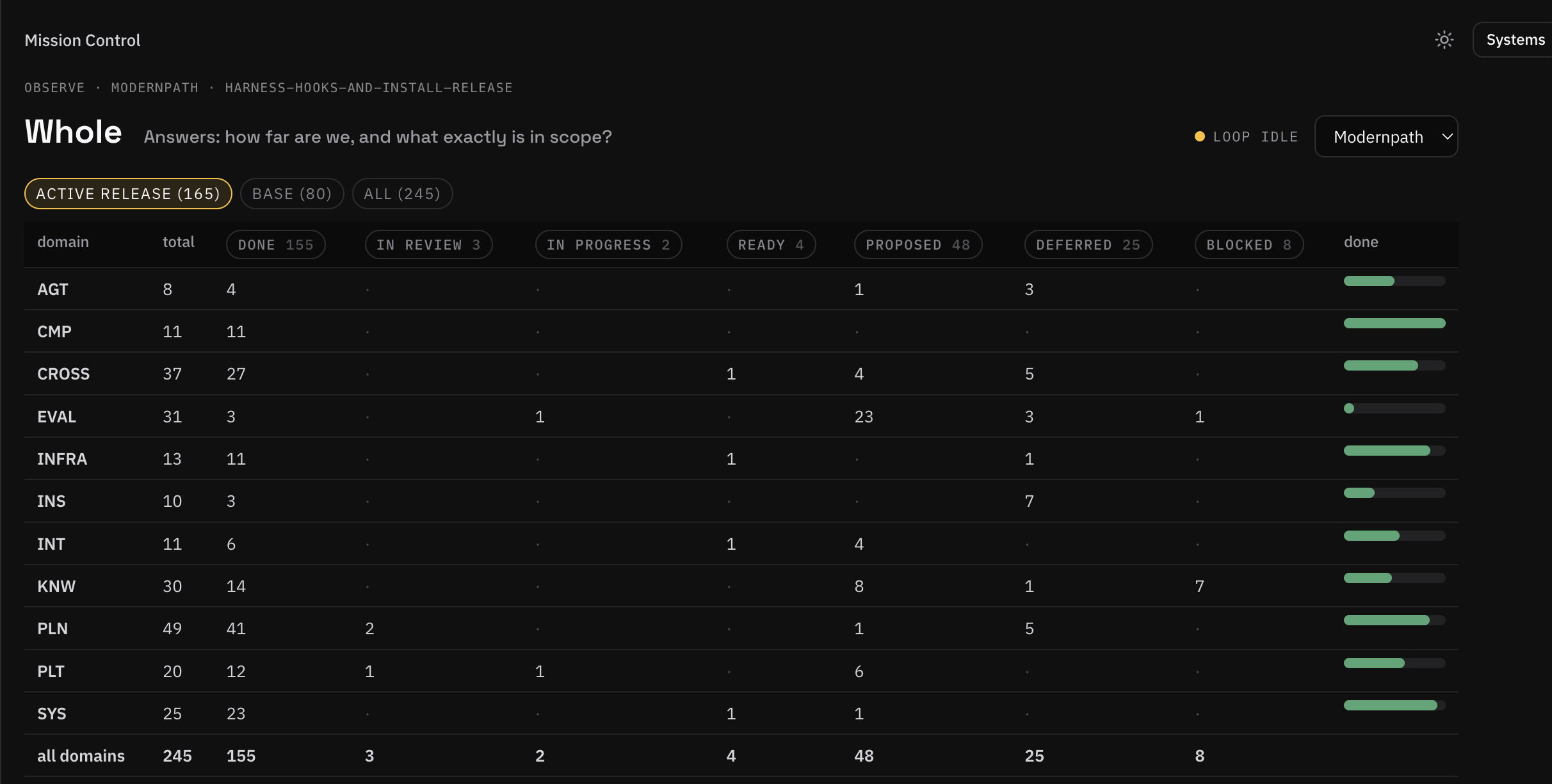
The real-time view of the record, for everyone: progress computed from artifacts, requirements linked to development status, decisions queued to the people who own them, with what each answer unblocks. If it isn't here, nothing needs you.
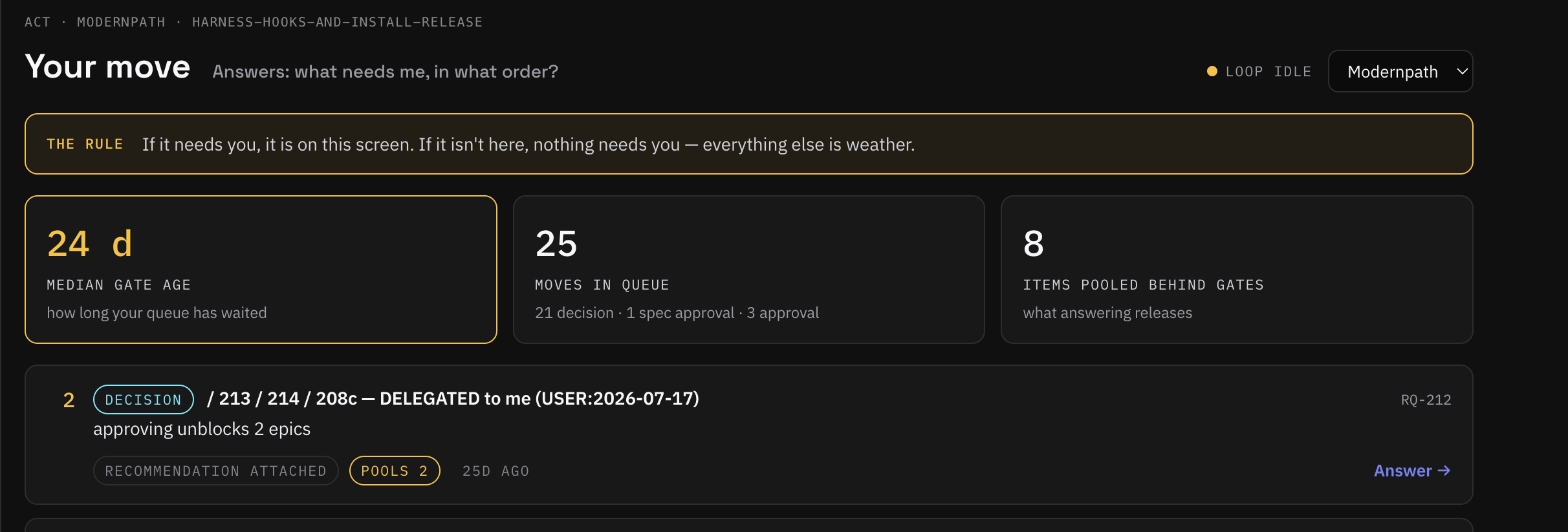
1one screen, zero status meetings2answers un-pool blocked work3impact shown before you decide
A record that compounds, and never resets
Explore the queryable graph of requirements, decisions, code, and tests: search across everything, trace any requirement to the code that realizes it, view decision records and rationale, run impact analysis and what-if simulations.
- Requirements245
Requirement
First-class acceptance criteria
ApprovedADR-007 · Acceptance criteria live as rows
3 modules
7 tests
All greenRun #482 · coverage 96%
Harness sessions reset to zero at every boundary. The record compounds, cycle after cycle.
Governance & control
Governed at every layer
Human approval gates
Policy enforcement & RBAC
Audit & immutable history
System of Record integrity
Compliance & regulation
Inside the Knowledge Core
See your architecture the way the AI does
Patterns and conventions
Capability index
Architecture Browser
Enterprise-ready
European infrastructure, defense in depth
Defense in depth
Data residency