A guide for engineering leaders

The AI-Native Maturity Model

Your developers got faster. Your delivery didn't. A five-level model for closing the gap — and the process that moves a team up it.

Individual developers using AI coding tools get faster almost immediately. Teams mostly do not. Research across 22,000 developers found no significant correlation between AI adoption and company-level performance — the gains are absorbed by review, testing, and release pipelines that were never modernised to match.

14 pages · Free · Tested on 2M lines of production code

500 → 1

developer-days to a single day — a COBOL-to-Java modernisation, reproduced twice

3x

delivery velocity, platform-driven spec-to-code

2M

lines of Go and React — the unfamiliar codebase the process was tested on

19

stages in one autonomous run, documented start to finish

Figures from ModernPath client work and platform runs. Full context in the guide.

Who it's for

CTO

“We bought the licences. The delivery numbers didn't move.”

VP Engineering

“Every developer uses AI differently and I can't standardise it.”

Head of Architecture

“AI writes code that runs and doesn't fit our system.”

The two ideas behind the guide

Two frames do most of the work. Everything else in the guide follows from them.

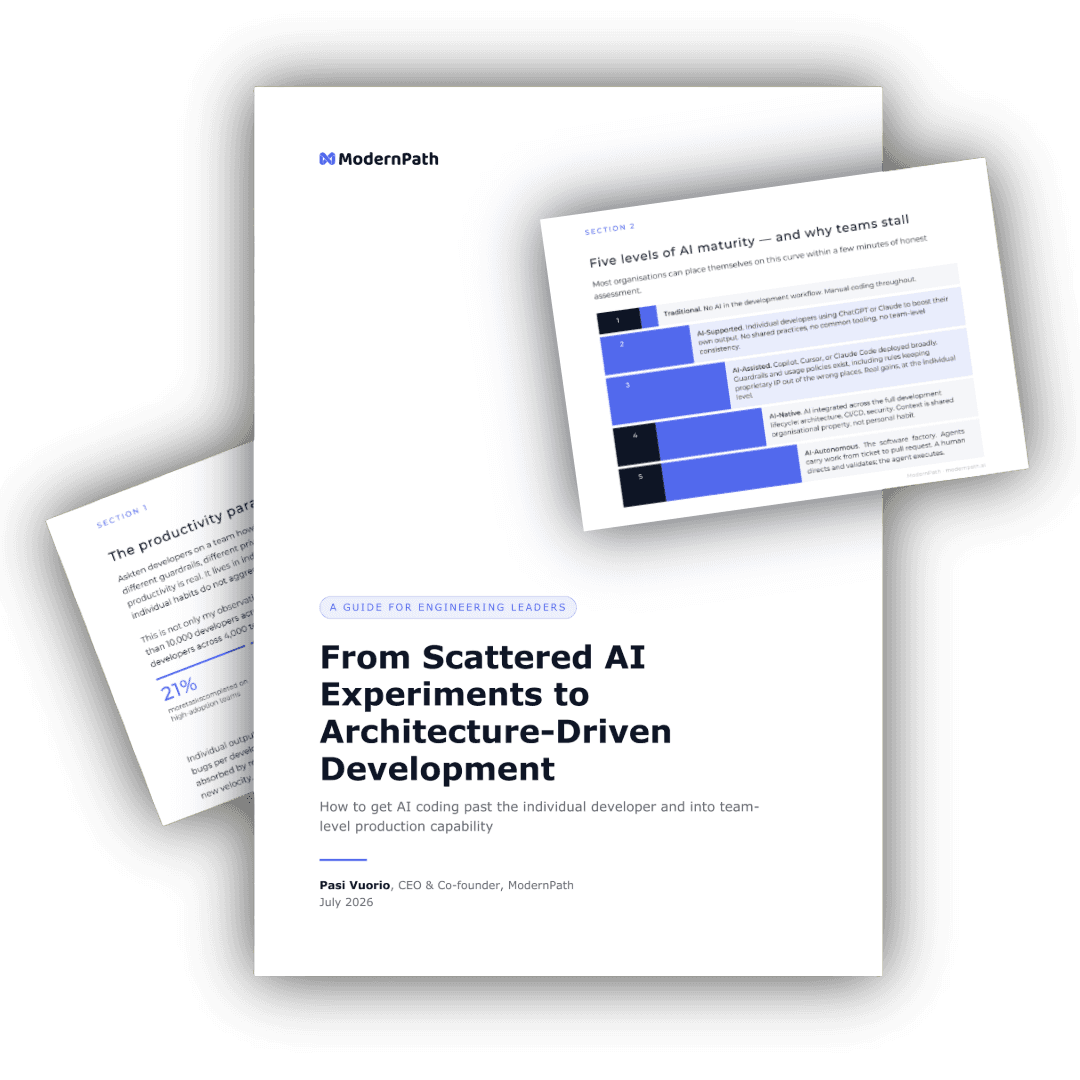
Five levels of AI maturity

Most Nordic engineering organisations sit at level 2 or 3. The guide covers the four structural reasons they stall there.

  1. Level 1

    Traditional

    No AI in the development workflow. Manual coding throughout.

  2. Level 2Most teams are here

    AI-Supported

    Individual developers using ChatGPT or Claude to boost their own output. No shared practices, no common tooling, no team-level consistency.

  3. Level 3Most teams are here

    AI-Assisted

    Copilot, Cursor, or Claude Code deployed broadly. Guardrails and usage policies exist, including rules keeping proprietary IP out of the wrong places. Real gains, at the individual level.

  4. Level 4

    AI-Native

    AI integrated across the full development lifecycle: architecture, CI/CD, security. Context is shared organisational property, not personal habit.

  5. Level 5

    AI-Autonomous

    The software factory. Agents carry work from ticket to pull request. A human directs and validates; the agent executes.

Why a specification alone isn't enough

A specification written from the requirement assumes the system will accommodate it. In a brownfield codebase, that assumption is where changes fail.

Spec-driven development

The specification describes what should be built. It is written against the requirement.

  • States intent
  • Defines acceptance criteria
  • Assumes the system will accommodate it

Grounded Spec-Driven Development

The specification is additionally anchored to a verified understanding of the existing system.

  • Names the subsystems it touches
  • Names the patterns it must follow
  • Names the interfaces it must not break
  • Names the prior decisions that constrain it

What's inside the guide

The productivity paradox

What the research across 22,000 developers actually found, and why individual speedups stop at the team boundary.

Five levels of AI maturity

Where most Nordic engineering organisations sit today, and the four structural reasons they stall at levels 2–3: bounded context, cross-repository dependencies, the brownfield reliability bar, and architectural drift.

What changed: three years of capability

The curve from code completion to the software factory, and two cases from our own work, including a COBOL-to-Java modernisation that took a team half a year and now runs in a day.

Grounded Spec-Driven Development

Our extension of spec-driven development, where every specification is anchored to a verified understanding of the system it will change. The difference between a spec that states intent and a spec that names the interfaces it must not break.

The four-phase process

Document, Spec, Develop, Audit, with audit findings feeding back into the documentation. And why review capacity becomes the constraint once generation gets cheap.

The three layers a team needs

Context, process, and orchestration: what each is responsible for, whatever tooling you use.

What to measure

Four metrics worth holding yourself to: accuracy and hit rate, token efficiency, rework and pass count, and team-level delivery velocity.

What engineering leaders are asking

Five questions from CTOs and architects, including the ones without good answers yet: token economics at scale, IP ownership in AI-generated code, and when spec-driven development becomes intent-driven.

Where to start

A five-step sequence for a first bounded project, and the most common mistake teams make.

Also included: a self-assessment table for placing your team on the curve, and a pre-flight checklist for your first architecture-driven build.

Tested in practice

The guide documents a full run against an open-source codebase of roughly two million lines of Go and React that the models had no prior familiarity with — a 19-stage implementation, start to finish, including where it fell short.

“I wish I had shared his confidence. Honestly, I didn't believe the project would succeed.”

Janne Tammi · Lemonsoft

Get the guide

14 pages, free. Leave your email and the PDF downloads straight away.

The AI-Native Maturity Model · PDF

The download starts right after: no email confirmation loop.

Pasi Vuorio, Founder and CEO of ModernPath

About the author

Pasi Vuorio Founder & CEO, ModernPath

Over 30 years writing software, the last three AI-assisted. A repeat founder and one of the earlier adopters of agentic development in the Nordics. Pasi has trained more than 1,000 developers in AI-native software development.

Questions

Is this a sales pitch?
No. The guide is engineering guidance — the framework works with any vendor's models and your existing tooling. ModernPath appears in one section near the end, clearly marked.
How long is it?
14 pages, roughly a 25-minute read.
Do I need to be hands-on technical?
It's written for engineering leaders. No coding required, but it assumes you know what a brownfield codebase costs you.
Do I have to wait for an email?
No. The PDF downloads as soon as you submit the form.
What does ModernPath do?
AI coding tools generate code. ModernPath governs what they build. We map your architecture, patterns and dependencies so AI writes code that fits, then add the governance layer — workflows, audit trails, guardrails — so every AI-made change stays visible.
What is architecture-driven development?
Development where a system's architecture — its structure, patterns, interfaces and constraints — is captured explicitly and used as a direct input to every change, including AI-generated ones. In most teams that knowledge is tacit. That stops working once review becomes the constraint.
What is spec-driven development?
A workflow where a written specification, not a ticket or a prompt, is the unit of work. It states what should be built and what acceptance looks like; tests and code are generated against it. It solves ambiguity, but not fit.
What is grounded spec-driven development?
ModernPath's extension of spec-driven development: the specification is anchored to a verified understanding of the system it will change. It names the subsystems it touches, the patterns it must follow and the interfaces it must not break — not just the intent.

Already know where you sit on the curve? See how ModernPath works →