ModernPath vs. Spec-Driven Development: Why Architectural Intelligence Beats Spec-First Alone
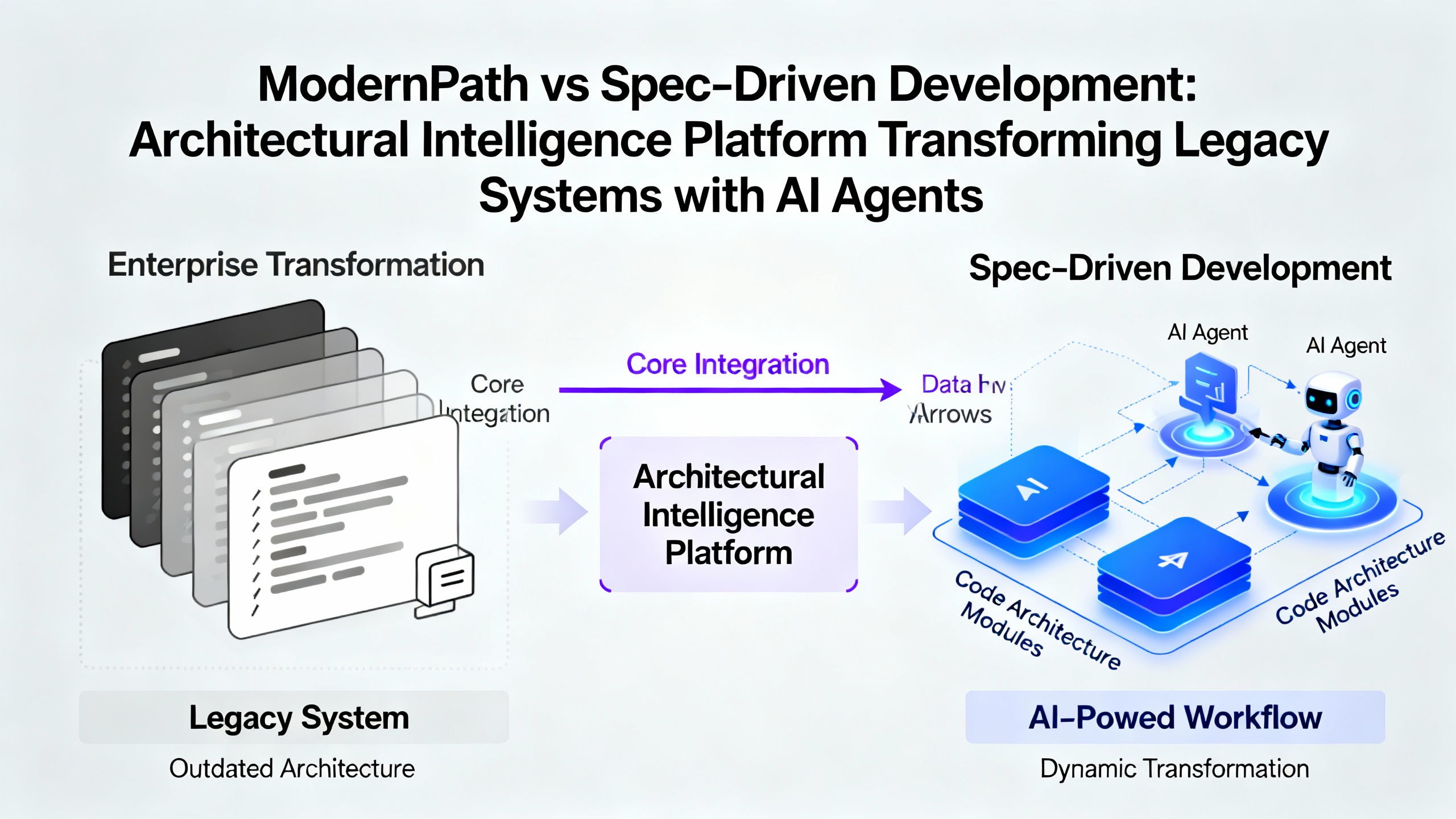
Spec-driven development frameworks like GitHub's Spec Kit enable AI agents to build greenfield applications. But what happens when you need to transform legacy systems at enterprise scale? Learn why architectural intelligence is the missing piece that enables AI-native transformation.
The Rise of Spec-Driven Development
GitHub's recent release of Spec Kit marks an important milestone in AI-powered software development. The framework enables developers to create detailed specifications that AI agents (like Claude Code or GitHub Copilot) can use to build entire applications from scratch. It's an elegant approach: write comprehensive specs, let AI agents implement them, validate the results, and iterate.
This spec-driven approach works remarkably well for greenfield projects. Starting from scratch, you can define your architecture, write detailed specifications for each component, and have AI agents generate clean, well-structured code that follows your vision.
But there's a fundamental limitation: spec-driven development assumes you're building something new. What happens when you need to transform existing legacy systems? What about the 80% of enterprise codebases that are undocumented, architecturally complex, and mission-critical?
The Enterprise Reality: Legacy Systems Aren't Greenfield
Most enterprises aren't building new applications. They're maintaining, extending, and modernizing systems that have evolved over decades. These systems represent:
- Undocumented Business Logic: Critical rules embedded in code that no one fully understands
- Complex Dependencies: Tight coupling between components that make changes risky
- Architectural Debt: Years of shortcuts and workarounds that compound over time
- Black-Box Estates: Systems understood by only a few senior developers nearing retirement
You can't simply write a spec for a legacy mainframe system and have AI rebuild it. The spec itself would require complete understanding of the existing system, which is precisely what's missing. This is where spec-driven development hits a wall.
What Spec-Driven Development Does Well
Before diving into the limitations, it's important to acknowledge what spec-driven frameworks like Spec Kit excel at:
Clear Development Process
Spec-driven development provides a structured workflow:
- Define: Create detailed specifications using templates
- Plan: Break down features into implementation tasks
- Implement: Have AI agents execute the plan with human oversight
- Validate: Test and refine the implementation
AI Agent Orchestration
Frameworks like Spec Kit handle the orchestration of AI agents, managing task sequences, dependencies, and execution order. This is crucial for complex projects where multiple components need to be built in the right order.
Greenfield Velocity
For new projects, spec-driven development can dramatically accelerate delivery. You can go from idea to working prototype in days rather than weeks, with AI handling much of the boilerplate and implementation details.
Consistent Quality
By working from detailed specifications, AI-generated code follows architectural patterns consistently. The resulting codebase is often cleaner and more maintainable than human-written code created under time pressure.
Where Spec-Driven Development Falls Short
The limitations of spec-driven development become apparent when you face enterprise-scale challenges:
No Existing System Understanding
Spec-driven frameworks start with a blank slate. They assume you're defining a new system from scratch. But when you need to modernize a legacy system, you first need to understand what you have:
- What are the current domain boundaries?
- How do components communicate?
- What are the data ownership patterns?
- Where is business logic embedded?
- What are the hidden dependencies?
Creating a spec requires this understanding, but spec-driven frameworks don't help you acquire it.
Single Codebase Focus
Spec Kit and similar frameworks focus on building individual applications. But enterprises have multiple codebases (mainframe systems, legacy monoliths, microservices, external integrations) that need to work together. Spec-driven development doesn't address cross-system architecture or organization-wide transformation.
Limited Incremental Transformation
When modernizing legacy systems, you can't afford big-bang rewrites. You need to transform incrementally while maintaining business continuity. Spec-driven development is optimized for creating new systems, not gradually transforming existing ones.
Missing Architectural Intelligence
Writing specs requires architectural expertise. Spec-driven frameworks assume you already know the right architecture for your problem. But what if you're working with legacy systems where the current architecture is unclear? What if you need help designing the target architecture?
ModernPath's Approach: Architectural Intelligence First
ModernPath addresses these limitations by starting where spec-driven development ends: with complete understanding of your existing systems.
Step 1: Analyze and Document Current Architecture
Before writing any specs, ModernPath ingests your entire codebase (code, documentation, APIs, tests, knowledge bases) to build a comprehensive architectural model:
- Domain Boundaries: How business domains are currently organized
- Dependencies: All system dependencies and data flows mapped
- Data Paths: How data moves through the system
- Service Contracts: Existing interfaces and APIs documented
- Business Logic: Rules and patterns embedded in code
This step typically takes 2 to 4 weeks and produces complete architectural documentation. You gain 100% system understanding before making any changes.
Key Difference: Spec-driven development assumes you're starting fresh. ModernPath starts by understanding what you already have.
Step 2: Design Target Architecture
With complete understanding of your current system, ModernPath generates candidate target architectures:
- Multiple architectural options with trade-offs
- Migration complexity and risk assessment
- Performance and scalability implications
- Cost and resource requirements
- Time to value estimation
For each workload or domain, you choose the right modernization path based on complete understanding, not guesswork.
Key Difference: Spec-driven development requires you to define architecture upfront. ModernPath helps you design the target architecture based on your existing systems.
Step 3: Plan Tasks with Architected Specs
Now ModernPath creates specs, but these are informed by complete system understanding:
- Interface Contracts: Specifications that maintain system integrity
- Expected Functions: Requirements that align with existing patterns
- Architectural Constraints: Rules that ensure code fits the target architecture
- Test Specifications: Validation that covers architectural scenarios
These specs enable automatic checking of coupling, performance, resilience, and architectural compliance on every change.
Key Difference: Spec-driven development creates specs from scratch. ModernPath creates specs informed by complete architectural understanding of both current and target states.
Step 4: Orchestrate Teams and AI Agents
Like spec-driven frameworks, ModernPath orchestrates AI agents to execute the plan. But with a crucial difference: the AI agents work from architected specifications that maintain system integrity:
- AI-generated code aligns with both current and target architectures
- Changes maintain system integrity throughout transformation
- Human expertise guides critical decisions
- Complete audit trails ensure compliance
Key Difference: Spec-driven development orchestrates agents for greenfield projects. ModernPath orchestrates agents for incremental transformation with architectural guardrails.
Step 5: Review, Document, and Visualize Outcomes
ModernPath provides visibility into transformation progress:
- Before/after architectural visualization
- DORA metrics for delivery health
- Progress tracking toward target architecture
- Living documentation that stays current
Insights feed back into the model to prevent architectural drift and guide the next sprint.
Key Difference: Spec-driven development focuses on building features. ModernPath tracks architectural transformation progress.
When to Use Each Approach
Use Spec-Driven Development When:
- Building Greenfield Applications: Starting from scratch with clear requirements
- Well-Defined Architecture: You know the architecture you want
- Single Codebase: Building one self-contained application
- Rapid Prototyping: Need to quickly validate ideas
- Small Teams: Working with limited developers on focused projects
Use ModernPath When:
- Legacy Modernization: Transforming existing systems
- Black-Box Estates: Undocumented or poorly understood codebases
- Enterprise Scale: Multiple codebases across the organization
- Incremental Transformation: Need to maintain business continuity
- Architectural Uncertainty: Need help designing target architecture
- Compliance Requirements: Need complete traceability (like DORA)
- Organization-Wide Transformation: Scaling AI-native development across teams
The Complementary Relationship
ModernPath and spec-driven development aren't mutually exclusive. They're complementary approaches that address different challenges:
Spec-driven development excels at the execution phase: orchestrating AI agents to build features from clear specifications. It's the “how to build” framework.
ModernPath excels at the understanding and architecture phase: analyzing existing systems, designing target architectures, and creating specifications informed by complete system knowledge. It's the “what to build and why” platform.
In fact, once ModernPath has analyzed your systems and created architected specifications, you could use spec-driven development frameworks to execute specific features. The key is having the architectural intelligence to create the right specifications in the first place.
Real-World Example: Financial Services Modernization
Consider a bank modernizing a 30-year-old COBOL mainframe system:
Spec-Driven Approach Alone:
- Try to write specs for the new system
- Realize you don't fully understand the existing business logic
- Spend months manually documenting the current system
- Discover hidden dependencies during implementation
- Face compliance issues due to incomplete change documentation
- Risk failure due to big-bang rewrite approach
ModernPath Approach:
- Weeks 1-4: Analyze and document the complete mainframe architecture
- Weeks 5-6: Design multiple target architecture options with trade-off analysis
- Week 7: Choose optimal path per workload (some to cloud, some to microservices, some to keep)
- Weeks 8+: Transform incrementally with architected specs and AI agents
- Throughout: Maintain complete audit trails for DORA compliance
- Result: Successful transformation without business disruption, 3x team productivity, full compliance
The Bottom Line
Spec-driven development represents an important evolution in AI-powered software development. It provides structure, orchestration, and process for AI agents to build software from specifications.
But specifications alone aren't enough for enterprise transformation. You need architectural intelligence:
- Understanding existing systems before transforming them
- Designing target architectures informed by current state
- Creating specifications that maintain system integrity
- Orchestrating transformation across multiple codebases
- Providing complete traceability for compliance
- Enabling incremental transformation without big-bang rewrites
ModernPath doesn't replace spec-driven development. It provides the architectural intelligence foundation that makes spec-driven execution successful at enterprise scale.
If you're building a new application from scratch, spec-driven frameworks like Spec Kit are powerful tools. But if you're transforming legacy systems, modernizing enterprise architectures, or scaling AI-native development across your organization, you need architectural intelligence first.
That's where ModernPath comes in. We bridge the gap between undocumented legacy complexity and AI-powered development, ensuring your transformation is guided by complete architectural understanding from day one.