Brownfield AI: Why Your Legacy Code Needs an Architect, Not a Copilot
The Greenfield Fantasy
Watch any AI coding demo: "build me a todo app" and Cursor or Devin generates a working application in minutes. Impressive—but irrelevant to most enterprise software work.
Most enterprise IT budgets go to maintaining existing systems, not building new ones. Legacy systems contain decades of embedded business logic. The original architects are gone, documentation is stale, and the code is a black box.
This is brownfield development—the messy reality of enterprise software. And most AI coding tools aren't built for it.
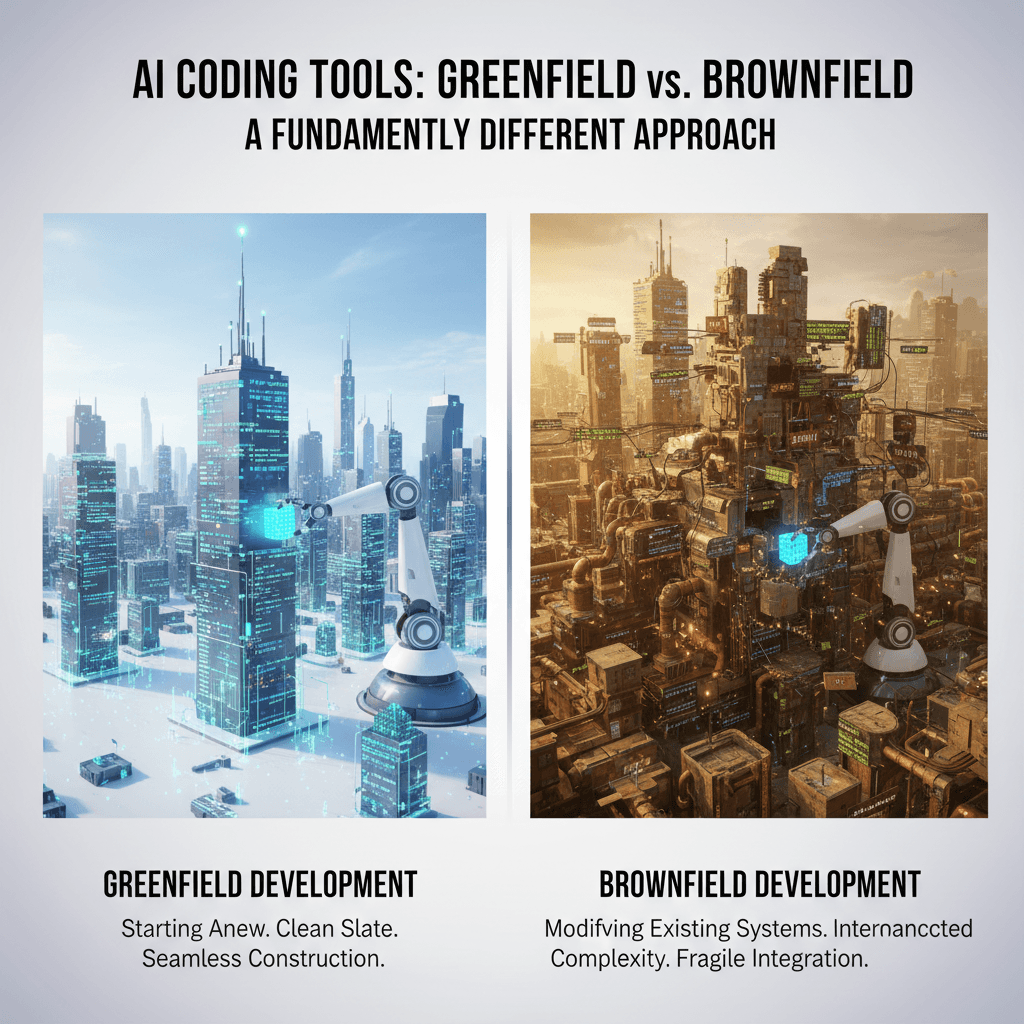
Greenfield vs. Brownfield
Greenfield: Building from scratch. No constraints, clean architecture, modern patterns. AI tools excel here—the LLM has full context because there's no existing codebase.
Brownfield: Working with existing systems. Complex dependencies, undocumented rules, accumulated technical debt, integrations everywhere. AI tools struggle because they see fragments—individual files—but lack architectural understanding.
The AI Productivity Problem
Organizations adopting AI coding tools on legacy codebases often see initial gains evaporate. The pattern:
- AI generates code based on training data patterns
- Those patterns violate your existing architecture
- You debug and fix the output
- The "fix" introduces more inconsistency
- Technical debt compounds
The AI makes your codebase worse, not better. The root cause: organizations treat AI as a faster developer when they need an architectural partner.
What Brownfield AI Requires
System Understanding: Before changes, AI must understand business logic, architectural constraints, dependencies, and data flows. This requires systematic analysis and knowledge graphs—not just a large context window.
Architecture-Driven Development: AI should generate code that fits your architecture—following your patterns, using your utilities, respecting your boundaries. Not generic patterns from training data.
Impact Analysis: What systems are affected? What tests need updates? Does this comply with security requirements? In greenfield these questions don't exist. In brownfield, they're everything.
Knowledge Preservation: When developers leave, understanding goes with them. Lemonsoft hit exactly this wall on a codebase refined over years. Brownfield AI must capture knowledge, maintain documentation, and build living models that evolve with the codebase.
The ModernPath Approach
The AI is not your coding assistant. The AI is your system architect.
Our 5-step process:
- Analyze: Ingest entire codebase, build living model of domains, dependencies, data paths
- Design: Generate target architecture candidates, define service contracts
- Plan: Convert goals into agent-ready specs with architectural constraints
- Execute: Orchestrate AI agents with human oversight and architectural context
- Review: Visualize outcomes, track metrics, feed insights back to prevent drift
Continuous vs. Project-Based
Traditional modernization tools (vFunction, CAST) deliver a project. It ends. Teams return to ad-hoc development. Debt accumulates again.
ModernPath's Knowledge Core stays. It maintains context, enforces consistency, detects drift, and accelerates all future development. Brownfield AI isn't a project—it's an ongoing capability.
When to Use What
Greenfield tools: New applications with no legacy constraints, prototypes, isolated services.
Brownfield AI: Modernizing existing systems, adding features to legacy codebases, building services that integrate with your portfolio.
Most enterprise work is brownfield. Even "new" projects integrate with existing auth, use established data models, and connect to the broader portfolio. Brownfield-aware development should be the default.
The Bottom Line
The AI coding revolution is real. But for enterprises with existing systems—nearly all of them—it requires a different approach.
The future isn't AI that writes code faster. It's AI that understands systems deeply.
The question isn't whether to adopt AI. It's whether to adopt AI that understands your reality—or AI that pretends your legacy doesn't exist.
ModernPath builds the Agentic Engineering OS for legacy to AI-native software transformation.